

There are moments in history when a new technology emerges and captures our attention. We race to understand what it can do, how fast it will move, and whether it will disrupt the industries and institutions we have built. Yet the deeper question is rarely technological. It is human.
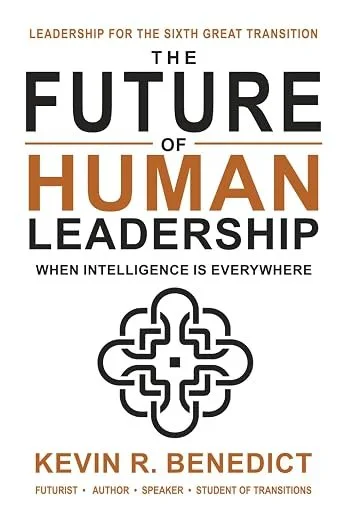
That was the heart of my recent conversation with Kevin Benedict, futurist, author, lecturer, and host, whose latest work explores what leadership must become in a world increasingly shaped by artificial intelligence.
What struck me most was that Kevin did not write another book about AI. He wrote a book about responsibility.
As builders, owners, executives, and leaders, we often become captivated by capability. We want better tools, faster systems, and greater productivity. There is nothing wrong with that. Progress has always been part of the human story. But Kevin argues that our challenge today is not that artificial intelligence is advancing too quickly. Our challenge is that leadership is not advancing at the same pace. The question is no longer what technology can do. The question is what we are going to do with it.
He framed this moment as a transition unlike those that came before it. The Industrial Revolution amplified human muscle. The Information Age amplified communication. What makes this era different is that intelligence itself is being amplified and distributed. Decision making, perception, memory, pattern recognition, and action are no longer confined to individuals or even organizations. They are increasingly shared across networks of humans and machines. As Kevin observed, the speed of consequence is beginning to exceed the speed of comprehension.
That observation should give every leader pause.
Too often we focus on individual technologies. We evaluate artificial intelligence, biotechnology, climate pressures, demographic shifts, or geopolitical challenges as separate forces. Kevin encouraged us to look beyond the individual waves and pay attention to the tide. Real disruption occurs when these forces begin interacting with one another. It is the convergence of change that reshapes markets, institutions, and societies.
For leaders, this changes the nature of leadership itself.
For generations, authority was linked to knowledge. The leader was expected to be the smartest person in the room. That model is rapidly becoming obsolete. When intelligence is available everywhere, leadership is no longer about possessing the answers. Leadership becomes the ability to orchestrate intelligence, govern complex systems, and exercise judgment. Machines can generate answers. They cannot determine meaning. Machines can optimize outcomes. They cannot decide whether those outcomes are worthy of pursuit. Judgment remains profoundly human.
That insight connects deeply with what we see through The Great Conversation.
Many organizations measure success through productivity, efficiency, and financial performance. Those measurements matter, but they do not tell the whole story. A company can appear healthy on paper while quietly eroding trust, resilience, meaning, and engagement among its people. Kevin described this as a paradox of modern leadership. Organizations can become more capable while human beings become less capable. The dashboard remains green while the people behind it drift toward exhaustion and disengagement.
One reason this happens is the loss of agency.
People can endure uncertainty. They can adapt to change. What they struggle with is the belief that life is happening to them rather than with them. When agency disappears, ownership disappears. When ownership disappears, creativity begins to fade. Any leader who has watched culture deteriorate understands the truth of that progression. Sustainable value creation requires people who feel connected to the outcomes they help create.
Perhaps the most compelling framework Kevin shared was his concept of three forms of intelligence.
Human intelligence helps us answer the question, "Should we?"
Machine intelligence helps us answer the question, "Can we?"
Ecological intelligence helps us answer the question, "What happens next?"
Healthy leadership requires all three. Yet we increasingly overvalue machine intelligence because it provides immediate answers and measurable outputs. At the same time, we undervalue ecological intelligence, the wisdom that emerges from understanding systems, relationships, adaptation, and long term consequences. Nature has been solving problems of resilience and survival for billions of years, yet its lessons are often absent from our decision making.
This led our conversation toward stewardship.
Kevin believes stewardship is becoming the defining leadership model for the future. Ownership is temporary. Consequences are not. Every leader inherits systems they did not build and leaves behind systems they will never fully control. Stewardship asks leaders to think beyond quarterly performance and beyond personal gain. It invites them to consider the people, institutions, communities, and future generations connected to their decisions.
His concept of flourishing together builds on that idea. Success cannot be measured in isolation. A business cannot claim victory if its people are depleted. A society cannot claim progress if future generations inherit fewer opportunities. A market cannot remain healthy if its larger ecosystem is weakened. Flourishing requires a broader view of value and a deeper understanding of interdependence.
In many ways, this conversation returned us to a timeless tension.
Modern systems reward speed. They celebrate immediacy and acceleration. Reality rewards wisdom. The challenge facing every leader is knowing when speed is required and when reflection is necessary. The future may belong to organizations that can move quickly, but it will certainly belong to leaders who can think deeply.
As our discussion came to a close, Kevin offered what may be the most important leadership question of our time:
Whom do I serve?
In an era where intelligence is becoming ubiquitous, where technology can generate answers faster than ever before, leadership will not ultimately be defined by capability. It will be defined by responsibility. The future does not turn on the power of machines. It turns on the character, judgment, and stewardship of the humans who lead them.
That is a conversation worth having. More importantly, it is a question worth carrying with us long after the conversation ends.